Posts

Fungus - The plastic of The Future?

Image
  Plastic was first invented in 1855. In the past 70 years, we humans have refined its use, so much so that today around 380 million tonnes of plastic is produced worldwide each year. But not everyone was following the crowd, in 2006 a small company in New York came up with a possible alternative to plastic that was both sustainable and eco-friendly.    What is Mycelium Fungus? Mycelium Technology was first introduced by ‘Ecovative Designs’ in 2006. Mycelium is a multicellular fungus that produces a branched network of fine, white filaments that grow underneath the ground. It may sometimes develop into visible structures like mushrooms. Think of it as the root structure of a mushroom.  M ycelium growing in a petri dish on coffee grounds This mycelium can be used to create different structures by providing it a framework in a controlled environment. The cells are grown to create intricate 3D structures that form materials like a brick or a piece of packaging or ev...

Reusable Rockets

Image
  1. What is the main incentive behind the idea of a reusable rocket system? Traditionally, we had a tried and tested system of launching rockets that had been in use for over three decades and that has been used enough times to ensure minimum failure rate. This was the Expendable rocket launch system where we would divide the parts of the rocket, each part to serve the requirements of the different stages of launch of a rocket and as each stage was executed the parts responsible for the stage would detach from the rocket and in the end only the final satellite would reach the destination or orbit. But, as the technology with these systems improved and as more and more rockets and satellites began to be launched into outer space, people found out two major problems with the system that was in use. First one being that the price of operation of a single rocket launch had increased by up to three-fold for certain large-scale launches. The second problem, which was slightly more...

3D Printing - A Leading Edge Technology

Image
  3D printing  is a manufacturing process to fabricate physical object of materials like polymers, metals, composites, bio-materials, edibles, etc. from the object’s  Computer-Aided-Design [CAD] Model  i.e., its digital model. There are two types of processes 1) Additive manufacturing processes 2) Subtractive manufacturing processes In additive manufacturing process, the material is added to form a product while in subtractive manufacturing process, the material is removed in order to create an object. 3D printing  comes in the category of  additive manufacturing processes  as it creates an object by layering method. It is possible to manufacture products with wide range of size, shape, colour, rigidity, and with variety of materials which are either in powdered or melted form. 3D printing technology:                                            ...

Fundamentals Of Cyber-Security

Image
  Introduction The internet is home to the biggest information sharing network ever created with billions of devices that communicate across the globe. In developed economies, the average person now owns multiple devices, which are essential to most aspects of daily life. In this digital landscape, everyone is susceptible to getting hacked. Cyber-attacks impact large technology companies, financial institutions, media organizations, dating websites, political parties, small companies, and individuals just like us. Cyber-security is important because of the unprecedented amounts of data that we as individuals and organizations collect, store, and process on our electronic devices. As the volume and sophistication of cyber attacks grow, we are all tasked with safeguarding this information. Think about what we need to protect now and in our future! What is cyber Security? cybersecurity is the practice of protecting and recovering networks, devices, and programs for many type of ...

Know more on QR codes

Image
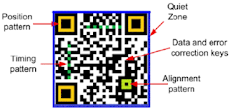
  QR Codes QR code is one of the most trending technology being used to help users access certain information just with a scan using their smartphones. QR stands for Quick Response as the codes provide information to the user instantly.   History of QR codes: The  QR  code system was invented in 1994 by Masahiro Hara from the Japanese company Denso Wave. The initial design was influenced by the black and white pieces on a Go board. Its purpose was to track vehicles during manufacturing; it was designed to allow high-speed component scanning. Back then, Japan was going through a huge economic growth, and supermarkets selling a wide range of commodities from foodstuff to clothing began to spring up in many neighbourhoods. Cash registers that were then used at checkout counters in these stores required the price to be keyed in manually. Because of this, many cashiers suffered from numbness in the wrist and carpal tunnel syndrome. The invention of the ‘ Ba...

Industry 4.0

Image
  Industry 4.0  is one of the big  buzzwords  flying around our ear nowadays. We all wonder about what exactly it is!!!Basically it refers to the 4th industrial revolution where we have seen transformative technologies that have changed the industries.  We are now having machines -intelligent Robots connected with smart factories around us. How did we get here? First industrial revolution  had started in 1770s where we moved from hands to machines, from farms to first factories using steam and water power. Implementing these new technologies were not so easy, it took a long time to go ahead with these technologies. More newer things were happened to iron industry, mining and agriculture. They had soon adopted that. Second industrial revolution  had arrived 100 years later I.e., from 1871 to 1914 where electricity was invented. It has given birth to automation, assembly lines. Increasing electrification has given the kickstart to factories for modern pr...